E8 Oled First Look: Unboxing and Impressions
The landscape of premium home entertainment has shifted dramatically over the last several years, moving away from the bulky, backlit LED panels of the previous decade toward the sleek, self-emissive brilliance of Organic Light Emitting Diode technology. Within this competitive arena, the "E" series has consistently represented a unique intersection of high-end performance and avant-garde industrial design. With the arrival of the E8 OLED, there is a distinct sense that the technology has matured into its most elegant form yet. This first look explores the unboxing experience, the aesthetic footprint of the device, and the immediate performance impressions that set this model apart from both its predecessors and its contemporaries in the "C" and "B" series lineups.
Television buyers today are increasingly looking for more than just a screen; they are looking for a centerpiece that complements modern interior design. While performance remains king, the physical presence of the hardware is a major deciding factor for those investing in the upper echelons of the market. The E8 OLED attempts to satisfy this demand by utilizing "Picture-on-Glass" architecture, a design philosophy that minimizes the bezel and places the display panel directly onto a slim, transparent glass pane. This article delves into whether the substance beneath that glass lives up to the premium promise made by its outward appearance.
The Unboxing Experience and Initial Setup
Unboxing a flagship television is an event in itself, particularly when dealing with the E8’s fragile glass-on-glass construction. The packaging is robust, featuring heavy-duty corrugated cardboard and reinforced internal bracing to ensure the panel does not flex during transit. Upon opening the box, users are greeted with a well-organized accessory kit including the motion-sensing remote control, cable management ties, and the heavy weighted base. Unlike budget alternatives that often feel light and plastic-heavy, the components here have a reassuring heft, signaling the premium nature of the E8.
Setting up the E8 requires a steady hand and, ideally, two people. Because the screen is essentially a piece of glass, gripping it incorrectly can lead to undue stress on the OLED layers. Once the base is attached, the TV appears to float slightly above the surface of the media console, thanks to the transparent lower portion of the glass pane. This "floating" effect is the hallmark of the E-series and remains one of the most striking visual features in the industry. Initial power-on reveals a streamlined setup process that guides the user through Wi-Fi connectivity, account synchronization, and an automatic calibration routine that adjusts for ambient room lighting.
Design and Build Quality
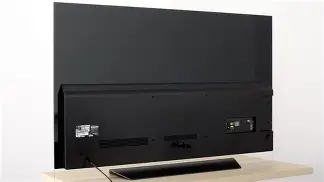
The E8 OLED is defined by its architectural elegance. The most notable design choice is the elimination of a traditional thick frame. Instead, the screen edges are finished with a microscopic metal trim that protects the perimeter of the glass. The back of the unit is split: the top half is remarkably thin—roughly the thickness of four credit cards stacked together—while the bottom half houses the internal processors, power supply, and an integrated sound system. This "bump" at the bottom is inevitable given current technological constraints, but it is handled with enough sophistication that wall-mounting remains a viable and attractive option.
One detail that buyers care deeply about is cable management. LG has addressed this with a recessed input panel and a series of clips that allow cables to be routed through the center of the stand or tucked neatly along the back. The build quality feels exceptionally rigid, though the glass front is highly reflective. In a darkened room, the glass disappears into the shadows, but in a bright living room, users will notice significant reflections of windows or lamps. This is a common trade-off with high-end OLEDs, which prioritize contrast over the matte finishes found on some specialized LED panels.
Picture Quality: The Alpha 9 Intelligence
At the heart of the E8 OLED lies the Alpha 9 Intelligent Processor. While the OLED panel itself provides the fundamental benefits—perfect blacks and infinite contrast—the processor is responsible for the heavy lifting of image treatment. During our first look, the most immediate observation was the cleanliness of the image. The Alpha 9 chip utilizes a quad-step noise reduction process that effectively eliminates the "grain" often found in low-bitrate streaming content without sacrificing the fine details of the actors' skin texture or clothing.
Color accuracy out of the box is strikingly high, particularly in the "Cinema" and "Technicolor" picture modes. Buyers often worry about the "soap opera effect" (motion smoothing), but the E8 offers granular control over these settings. The motion handling is fluid, making it a strong candidate for sports and action films, though purists will likely want to disable most of the interpolation features to maintain the original 24p cinematic feel. High Dynamic Range (HDR) performance is where the E8 truly shines. Supporting Dolby Vision, HDR10, and HLG, the TV can hit peak brightness levels that make specular highlights—like sunlight reflecting off water or the glow of a lightsaber—pop with incredible intensity against a pitch-black background.
Looking for the best TVs & Home Theater deals on Amazon?
Shop Amazon →Integrated Audio: The Glass Soundplate
Most thin televisions suffer from tinny, underpowered audio. The E8 attempts to circumvent this by using the lower portion of its glass structure as a waveguide for a sophisticated 4.2 channel, 60W speaker system. It supports Dolby Atmos, promising a wider soundstage than one might expect from a "naked" TV. In practice, the sound is surprisingly robust. Dialogue is prioritized and remains clear even amidst loud background scores, and there is a genuine sense of height and width in the audio when watching Atmos-enabled content.
However, users looking for deep, room-shaking bass will still find the internal speakers lacking compared to a dedicated subwoofer. For daily news watching and casual sitcoms, the E8’s internal audio is more than sufficient. For a true home theater unboxing experience, however, most buyers in this price bracket will likely pair the E8 with a high-end soundbar or a discrete surround sound system. That said, it is refreshing to see a manufacturer invest in audio quality rather than treating it as an afterthought.
Real-World Use Cases
When considering a purchase, different users have different priorities. Here is how the E8 OLED stacks up in common real-world scenarios:
The Dedicated Cinephile: This is the primary target for the E8. Because OLEDs can turn off pixels individually, the "True Black" performance is unrivaled. When watching a movie set in space, the star fields are pristine with no "blooming" (light leaking from bright spots into dark areas). The E8 provides an experience that is as close to a professional mastering monitor as most consumers will ever get.
The Next-Gen Gamer: Low input lag is a critical metric for gamers. The E8 performs exceptionally well here, with response times that are near-instantaneous. While it lacks some of the later HDMI 2.1 features found in even newer models, for the current generation of consoles, it provides a vivid, immersive experience with deep colors that make modern game environments feel much more alive.
The Bright Room Living Space: This is where buyers should be cautious. OLEDs do not get as bright as the most powerful QLED or Mini-LED TVs. If your room has floor-to-ceiling windows and you do most of your watching during the day, the E8 may struggle to fight through the glare. However, for evening viewing, its performance is difficult to beat.
Pros and Cons
- Pro: Stunning Picture-on-Glass design that serves as a high-end furniture piece.
- Pro: Perfect black levels and infinite contrast ratio for superior HDR performance.
- Pro: Alpha 9 processor provides some of the best upscaling and noise reduction in the industry.
- Pro: Support for major HDR formats including Dolby Vision and HLG.
- Pro: Surprisingly capable 60W internal audio system with Dolby Atmos support.
- Con: Glass-on-glass construction is extremely fragile and requires delicate handling.
- Con: Highly reflective screen can be problematic in rooms with significant sunlight.
- Con: Risk of permanent image retention (burn-in) if static elements are left on the screen for hundreds of hours.
- Con: Premium price point compared to the nearly identical picture quality of the C-series.
Detailed Specifications and Comparisons
To understand the E8's position in the market, it helps to look at how it compares to its sibling models. While the internal processing often remains the same across a year's flagship releases, the physical build and audio capabilities differ significantly.
| Feature | E8 OLED | C8 OLED (Comparison) | Typical LED/LCD |
|---|---|---|---|
| Panel Type | OLED (Self-emissive) | OLED (Self-emissive) | LCD with LED Backlight |
| Design Style | Picture-on-Glass | Traditional Slim Bezel | Medium/Thick Frame |
| Processor | Alpha 9 Intelligent | Alpha 9 Intelligent | Standard Varies |
| Audio Output | 60W (4.2 Channel) | 40W (2.2 Channel) | 20W (2.0 Channel) |
| Black Levels | Perfect Black | Perfect Black | Dark Gray / Raised Blacks |
| Peak Brightness | ~700-800 nits | ~700-800 nits | 1000-2000+ nits |
Buying Guide: Is the E8 OLED Right for You?
Choosing a television at this level often comes down to a choice between aesthetic value and raw value. Because the E8 shares the Alpha 9 processor and the underlying OLED panel with the C8 model, the actual picture quality is virtually identical between the two. Therefore, the decision to buy an E8 is a decision to pay for the Picture-on-Glass design and the upgraded audio system.
Find top-rated TVs & Home Theater products at great prices.
See Deals →If you are planning to wall-mount your television and already have a high-end 7.1.4 Atmos surround sound system, you might find that the E8’s premium features are redundant. However, if the TV will be sitting on a piece of designer furniture where its transparent stand and glass borders can be appreciated, the E8 is worth the extra investment. It is a TV for someone who wants the technology to look as good when it is off as it does when it is on.
When shopping, consider your viewing habits. If you watch a lot of content with static logos (like news tickers or sports scores) for 10 hours a day, the risk of burn-in—while mitigated by modern software—is higher on an OLED than an LED. Conversely, if you primarily watch movies, prestige dramas, and play varied video games, the visual rewards of OLED are transformative. Ensure that your room can be significantly dimmed to see the E8 at its best. OLED technology is meant for the cinema experience, which thrives in controlled lighting environments.
Software and Smart Features
The E8 runs on the WebOS platform, which remains one of the most intuitive smart TV interfaces available. The "Magic Remote" acts like a wireless pointer, allowing you to select apps and navigate menus with simple gestures. This makes entering Wi-Fi passwords and searching for titles significantly less tedious than using a traditional directional pad.
Voice control is also heavily integrated. With a built-in microphone in the remote, users can search for content across multiple streaming platforms or control smart home devices directly from the screen. During our first look, the responsiveness of the OS was impressive; apps like Netflix and YouTube loaded in seconds, and switching between inputs was seamless. The E8 also includes a "Gallery Mode," which displays high-resolution paintings and photographs when the TV is not in use—a feature that perfectly leverages the Picture-on-Glass design to turn the TV into a piece of digital art.
Conclusion
The E8 OLED is a sophisticated piece of technology that manages to balance high-performance engineering with luxury design. It represents the pinnacle of what is possible when a manufacturer refuses to compromise on materials. While the panel technology provides the perfect blacks that enthusiasts crave, it is the glass-forward design and the refined Alpha 9 processing that elevate the E8 from a simple display to a centerpiece of modern home theater art.
For the buyer who values the integration of form and function, the E8 offers a compelling package. It addresses the common weaknesses of thin TVs—specifically poor audio and flimsy build quality—while doubling down on the visual strengths that have made OLED the gold standard for movie lovers. Though it demands a premium price and careful handling due to its glass construction, the immediate impressions suggest that the E8 remains one of the most striking and capable televisions on the market today. As home entertainment continues to evolve, the E8 stands as a reminder that the best experiences often come from a meticulous attention to both the picture we see and the hardware that presents it.